
- Home
- Company Information
- Important Financial Data
- Good Governance
- Shareholder Information
- Data Presentation
- Presentation documents
- Sustainability
- Anti-Fraud Policy
The Company places strong emphasis on maintaining high standards of safety and environmental responsibility. Hospital operations are managed with a focus on efficient energy utilization, ensuring resources are used effectively and deliver maximum benefit.
Waste management is systematically implemented across the Hospital, alongside rigorous environmental quality control measures. These include regular monitoring of indoor air quality and performance assessments of critical facilities, such as operating rooms (OR) and isolation rooms, to ensure compliance with established standards.
All initiatives are carried out with the utmost consideration for the safety of both service users and personnel within the Hospital premises.
Greenhouse Gas Management
The Company has initiated a systematic approach to measuring greenhouse gas (GHG) emissions by establishing a dedicated working team responsible for data collection and identifying initiatives to reduce emissions across its operations.
In early 2025, the Company participated in a pilot program for the Organizational Carbon Footprint Platform, organized by the Thailand Greenhouse Gas Management Organization (Public Organization), as part of its commitment toward achieving Net Zero emissions.
Performance in 2025
The Company has measured its greenhouse gas emissions across all scopes, including:
The results are as follows:
.png)
Based on the Company’s performance in 2025, greenhouse gas (GHG) emissions were reduced by 13.05% compared to 2024, significantly exceeding the short-term target of a 2% reduction, as detailed in the table above. The Company remains committed to continuously improving its operational processes to achieve its long-term sustainability goals.
In addition, the Company participated in the “Care the Bear” initiative, which focuses on promoting behavioral changes within organizations to reduce GHG emissions from events and activities.
In 2025, the Company successfully reduced paper usage in its activities, contributing to a measurable reduction in greenhouse gas emissions, as detailed below:
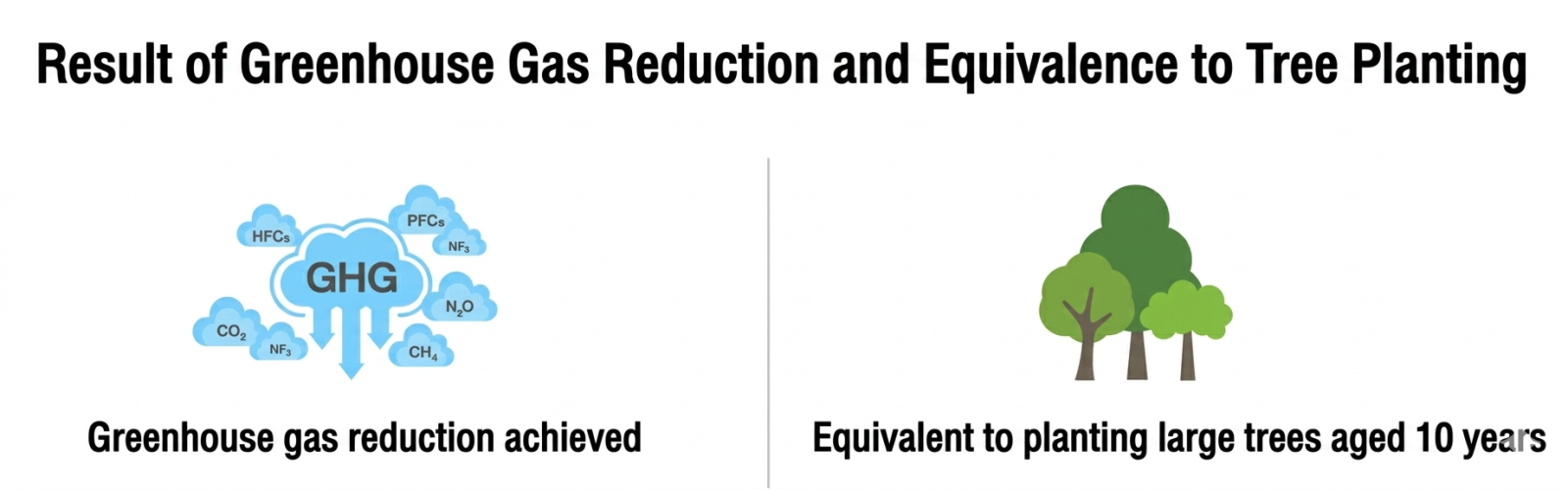
2024 | 21,929.45 kgCO2eq | 2,437 Trees |
2025 | 21,760 kgCO2eq | 2,290 Trees |
Total | 43,689.45 kgCO2eq | 4,727 Trees |
The greenhouse gas emissions data were verified by NPC Safety and Environmental Service Co., Ltd..
The certification document for greenhouse gas emissions verification is attached.
In 2025, the Company was rated “A” in the SET ESG Ratings by the Stock Exchange of Thailand, reflecting its strong commitment to sustainable business practices.
This achievement demonstrates continuous improvement from the “BBB” rating in 2024, and underscores the Company’s dedication to further enhancing its sustainability performance toward higher levels in the future.
Water and Wastewater Management
The Company recognizes the potential environmental impacts of wastewater discharge from hospital operations on surrounding communities.
The Hospital strictly adheres to regulatory requirements and ensures that no untreated wastewater is discharged into public waterways, while maintaining continuous compliance with applicable environmental standards.
Management Approach
Wastewater Management
The Company conducts regular inspection and maintenance of wastewater pumps in the central wastewater holding system. Chlorination is continuously applied to disinfect wastewater, and samples are collected and tested on a monthly basis prior to discharge.
All wastewater is discharged into the closed sewer system of the Bangkok Metropolitan Administration (BMA) and treated at the Din Daeng centralized wastewater treatment facility.
The system design and installation have been reviewed and approved by BMA officials. Relevant hospital departments have also participated in site visits and system evaluations.
Monthly monitoring is conducted through official reports obtained from the BMA, significantly reducing the risk of wastewater treatment system failure.
Water Consumption Reduction
The Company has implemented water conservation initiatives, including the gradual installation of sensor-based faucets in public restrooms to minimize unnecessary water usage.
In addition, awareness campaigns are conducted through signage and internal communication to encourage water-saving behavior among patients, visitors, and staff.
.png)
Performance in 2025
In 2025, total water consumption decreased by 13,182 cubic meters compared to 2024.
However, when measured as water consumption per patient day, the figure slightly increased to 1.94 cubic meters, representing a 2.11% increase compared to 1.90 cubic meters in 2024.
Based on these results, the Company will continue to enhance water management strategies to ensure alignment with its established targets and improve resource efficiency.
Energy Consumption
The Company is committed to optimizing electricity consumption efficiency in order to ensure the responsible use of natural resources, minimize environmental impacts, and reduce operational energy costs.
The Company strictly complies with the Energy Conservation Promotion Act B.E. 2535 (1992), as amended in B.E. 2550 (2007), and continuously implements energy management initiatives across its operations.
Management Approach
The Company has actively implemented energy efficiency measures since 1998, as demonstrated by its recognition through the Outstanding Energy Conservation Building Award from the Department of Energy Development and Promotion, Ministry of Science, Technology and Environment.
In 2025, the Company implemented key energy-saving measures as follows:
These on-peak energy reduction measures have been continuously implemented since 2023.
Energy Awareness and Maintenance
The Company actively promotes energy-saving practices among employees, encouraging the shutdown of unused lighting and equipment.
In addition, dedicated teams are responsible for the maintenance and optimization of electrical systems to ensure efficient operation and energy conservation.
Performance in 2025
.png)
In 2025, the Hospital’s total electricity consumption was 10,487,000 kWh, representing a decrease of 1,192,000 kWh compared to 11,679,000 kWh in 2024. This reduction was mainly attributable to a lower bed occupancy rate, which resulted in reduced overall electricity demand.
In addition, the Hospital implemented various initiatives and management measures to reduce electricity consumption, including campaigns encouraging employees to switch off unnecessary lights and equipment, the use of energy-efficient lighting, optimization of air-conditioning temperature settings, and the installation of solar panels as an alternative energy source.
In 2025, the Company was awarded the MEA Energy Awards 2025 at the Standard Level, reflecting its strong commitment to energy efficiency. This achievement underscores the Company’s ongoing efforts to advance sustainability and enhance its environmental stewardship.
Furthermore, the Company has dedicated teams responsible for the maintenance and upkeep of electrical systems to ensure efficient operation and energy conservation. Management also places strong emphasis on the adoption of renewable energy, including the installation of rooftop solar panels across five buildings, which generate electricity as follows:
Year | Electricity Generation from Solar Energy |
2022 | 524,467 kWh |
2023 | 536,104 kWh |
2024 | 516,994 kWh |
2025 | 500,711 kWh |
Garbage and Waste Management
Effective waste management is a critical aspect of healthcare operations. The Hospital has established a Waste Management Committee to ensure efficient, timely, and compliant handling and disposal of waste. This includes continuous monitoring of waste segregation, storage, collection, handling, transportation, and disposal processes.
Management Approach
In addition, infectious and hazardous waste is treated using high-temperature incineration, with operating temperatures not lower than 760°C and 1,000°C, in compliance with the Ministerial Regulation on the Disposal of Infectious Waste B.E. 2545 (2002) issued by the Ministry of Public Health and the Bangkok Metropolitan Administration Regulation on Waste and Sewage Management for Buildings and Healthcare Facilities B.E. 2545 (2002).
Performance in 2025
.png)
Environmental Awareness Initiatives
The Company also organized the “VIBHA GO GREEN” campaign to encourage patients, visitors, and employees to properly segregate waste in accordance with established guidelines.
Additionally, environmental awareness is incorporated into new employee orientation programs to instill a strong sense of environmental responsibility across the organization.
The Company conducts its business with a strong commitment to environmental responsibility, based on the belief that reducing both direct and indirect environmental impacts will generate long-term benefits for the business and society. Accordingly, the Company has established an Environmental Management Policy as a guiding framework applicable to employees, business partners, contractors, and all stakeholders, with the aim of promoting environmentally and socially responsible operations in an effective and consistent manner.
To ensure that environmental practices are implemented in a systematic and verifiable manner, the Company has appointed a Corporate Governance and Sustainability Committee to analyze, assess, and monitor environmental issues that may affect employees, service recipients, and surrounding communities, as well as to develop and oversee risk management plans related to the Hospital’s operations. The objective is to achieve an appropriate balance between business performance and sustainable environmental stewardship.
ดำเนินธุรกิจโดยคำนึงถึงผลกระทบต่อคุณภาพชีวิตของประชาชน สังคม และสิ่งแวดล้อม
ปฏิบัติและให้ความร่วมมือหรือควบคุมให้มีการปฏิบัติอย่างเคร่งครัดตามเจตนารมณ์ของกฎหมายและกฎระเบียบที่ออกโดยหน่วยงานกำกับดูแล
สร้างจิตสำนึกในเรื่องความรับผิดชอบต่อสิ่งแวดล้อมให้เกิดขึ้นในหมู่พนักงานทุกระดับอย่างต่อเนื่อง
มุ่งพัฒนากิจกรรมที่มีส่วนสร้างสรรค์ อนุรักษ์สิ่งแวดล้อมและทรัพยากร ธรรมชาติ อย่างสม่ำเสมอ
Following :
Privacy Policy | Cookie Policy ctipcoe
Copyright © Vibhavadi Hospital. All right reserved