Home

Driving the Business throughSustainability

The company is committed to driving a culture of sustainability across all business operations. It has established policies and sustainability management goals to serve as a framework for governance, ensuring alignment with business direction, corporate strategy, legal requirements, and relevant regulations. The company integrates sustainability into three key dimensions: Environmental (E), Social (S), and Economic & Governance (G). The company operates with integrity, transparency, and fairness under the principles of good corporate governance. It fosters innovation in products and services while recognizing the importance of promoting healthcare accessibility and reducing disparities in healthcare services. Additionally, the company is dedicated to delivering value across the entire supply chain, contributing to society, and enhancing environmental management. Furthermore, the company aligns its policies with the United Nations Sustainable Development Goals (SDGs) to ensure that its sustainability initiatives contribute to long-term global development objectives.

Sustainability Management Policy

Sustainability at Vibhavadi Hospital Sustainability at Vibhavadi Hospital

Highlights

Impact Management
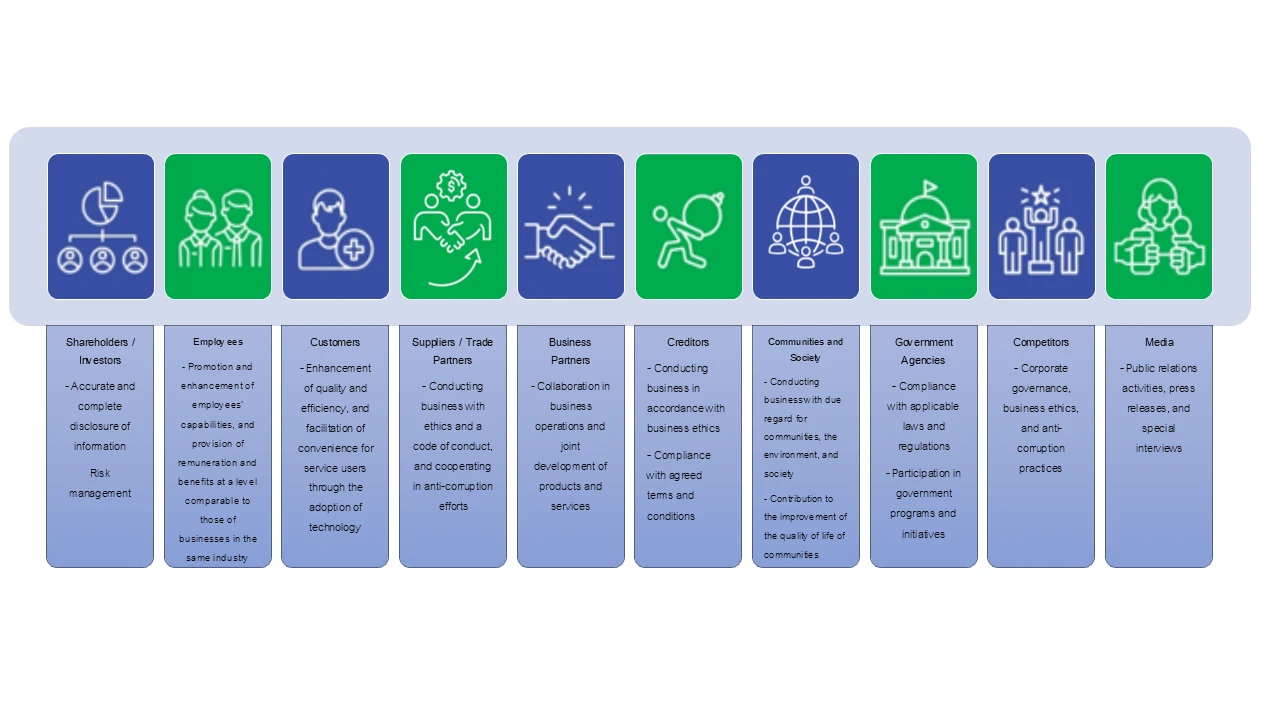
Stakeholders in the Business Value Chain

<span>Impact Management</span></br> Stakeholders in the Business Value Chain

Stakeholder Analysis

Participation Channels
  • shareholders’ meeting Investors relations Website/E-mail/ Opportunity Day Website / E-mail และ social media
Expectations
  • Providing quality medical care under professional standards.
  • There is oversight of good governance, including anti-corruption,
  • Providing services with care and a service mind.
  • Reasonable service rates.
  • Safety within the hospital’s premises and environment.
  • Customer confidential information protection
Equal treatment practices.
Activities
  • Develop the hospital into a tertiary hospital with an Excellence Center level.
  • Bring in Smart Service/Smart Operation/Smart Hospital systems to support the hospital’s operations.
  • Efficient procurement of medical equipment ensures.
  • Human rights
  • Compliance.


Participation Channels
  • Conduct meetings with employees at various levels.
  • Conduct satisfaction surveys and employee engagement.
  • Provide whistleblowing channels to support filing complaints
Expectations
  • Provide appropriate welfare and remuneration, and good quality of life
  • Provide a safe working environment, opportunities for advancement and work security.
  • Good working environment
  • Employee Potential Development
  • Equitable Treatment, Non-Discrimination
Activities
  • Provide welfare and remunerations that is compatible with businesses of the same type.
  • Provide a clearly defined career path.
  • Promote training, both inside and outside the organization, by stating the number of training hours in the work unit’s KPIs.
  • Human Rights
  • Occupational Health and Safety
Participation Channels
  • shareholders’ meeting
  • Investors relations
  • Website / E-mail Opportunity Day
Expectations
  • Good returns on investment, transparent and verifiable management practices.
  • There is oversight of good governance, including anti-corruption, transparency, and accountability.
  • Accurate, complete, and timely disclosure of information.
Activities
  • Compliance with good corporate governance principles.
  • Develop communication with shareholders and investors.
  • Risk management and business continuity management
Participation Channels
  • Website / E-mail / Telephone.
  • Meeting
Expectations
  • Equal treatment without discrimination
  • Business operations conducted with integrity, fairness, and transparency
  • Cooperation in business development
Activities
  • Conduct business ethically.
  • Provide cooperation to oppose corruption.
Participation Channels
  • Business cooperation
  • Product and service development.
Expectations
  • Return on investments.
Activities
  • Disclosure of business-related information.
Participation Channels
  • Website / Social Media
  • Organize meetings to receive comments and feedback.
  • Events
Expectations
  • Assisting and caring for society.
  • Building networks to collaboratively develop communities and societies
  • Improving the quality of life in communities and societies.
Activities
  • Carry out CSR activities on a regular basis.
  • Provide basic life support and resuscitation training.
Participation Channels
  • Website / Social Media
  • Business Visit
  • Attendance
Expectations
  • Compliance with terms
  • Risk Management
Activities
  • Business Ethics
  • Risk Management and Continuity Management.
  • Economic Value Creation
Participation Channels
  • Reports/meeting invitation
  • Reports / Attendance Letters / Events
Expectations
  • Comply with related regulations and laws supporting government activities.
  • Transparent disclosure of information
  • Supporting activities
Activities
  • Comply with relevant laws and regulations.
  • Cooperation in CSR activities.
Participation Channels
  • Collaborating as a network.
  • Organizing joint meetings among relevant.
Expectations
  • Fair competition
  • Compliance
Activities
  • Corporate Governance.
  • Business Ethics
  • Fighting against corruption.

test

Participation Channels
  • Press release/news announcement. ส่วนร่วม
  • Special interview.
Expectations
  • Reciving complete, accurate, and timely information.
  • Truthful news information disclosure.
  • Good media practices.
Activities
  • Corporate Governance.
  • Fighting against corruption.
  • Participating in community and social activities.

Assessment of Material Issues Related
Sustainable Development

In 2025, the Company conducted a comprehensive review of key risks and opportunities, taking into account the expectations and concerns of all stakeholder groups associated with operations across each activity within the value chain. This review also considered industry direction, sustainability trends, emerging risks, and significant global developments.
Adopting a holistic approach, the Company assessed both internal and external factors that may generate positive and negative impacts on the economy, society, and the environment, including human rights implications affecting the Company and its stakeholders.
This process was carried out in alignment with the principles of the Global Reporting Initiative (GRI Standards) and the United Nations Sustainable Development Goals (SDGs). The identified issues were subsequently prioritized through the Company’s sustainability management framework.
The outcomes of this process will be regularly communicated and reported to the Corporate Governance and Sustainability Committee, and subsequently presented to the Board of Directors for oversight and guidance.

 

Review of Material Sustainability Issues

Review of Issues
Sustainability Materiality

Engagement of Internal Stakeholders

Engagement of
Internal Stakeholders

Engagement of External Stakeholders

Engagement of
External Stakeholders

Prioritization of Material Issues

Prioritization of
Material Issues

Rationale

Rationale

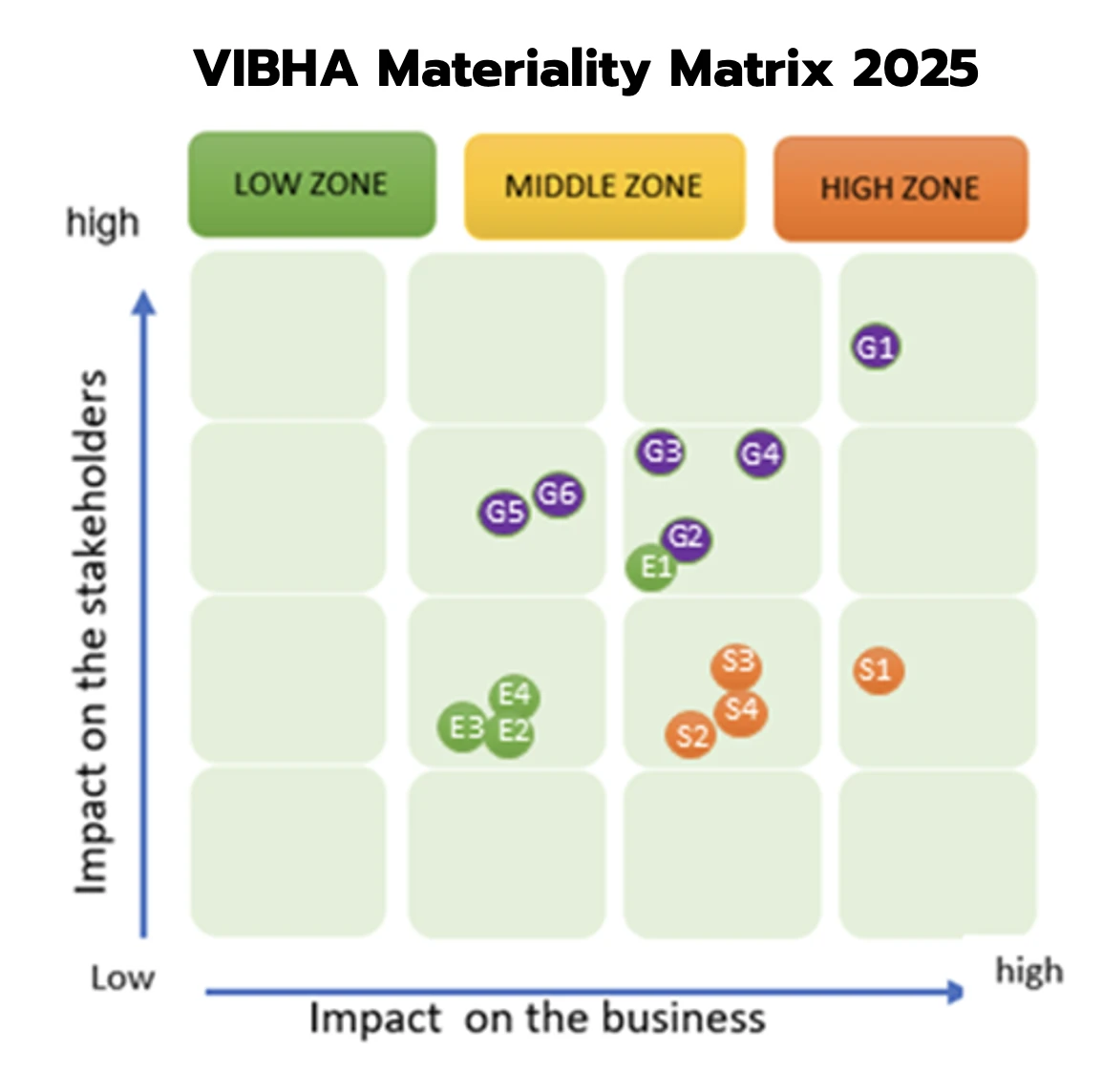
<span>Assessment of Material Issues Related</span></br> Sustainable Development

Economic

G1    Quality of Healthcare and Medical Services

G2    Corporate Governance

G3    Innovation and Technology Development
G4    Data Privacy and Confidentiality
G5    Supply Chain Management
G6    Sustainable Partnerships


Social

S1    Human Capital Development

S2    Respect for Human Rights, Equality, and Fair Labor Practices

S3    Occupational  Health, Safety, and Work Environment

S4    Community Engagement


Environment

E1    Garbage and Waste Management

E2    Energy Consumption

E3    Water and Wastewater Management

E4    Greenhouse Gas Management


Assessment of Material Issues for Sustainable Development

arrow-down

Targets and ApproachDevelopment Sustainability

Key Issues
  • G1 Quality of Healthcare and Medical Services
  • G2 Corporate Governance
  • G3 Innovation and Technology Development
  • G4 Data Privacy and Confidentiality
  • G5 Supply Chain Management
  • G6 Sustainable Partnerships

Management Approach and Performance Outcomes

1.    Quality of Healthcare and Medical Services

  • The Company is committed to continuously enhancing the quality of healthcare services through the development of patient rooms and facilities.
  • Enhancement of medical service quality through continuous improvement initiatives, including the provision of professional training programs in both medical practices and service excellence.

Performance in 2025

Indicator

Target (%)

2023

(%)

2024

(%)

2025

(%)

Inpatient Satisfaction (IPD)

96

92

96

96.33

Outpatient Satisfaction (OPD)

97

95

97

97.05


2.   Corporate Governance

  • The Company has established a Corporate Governance Policy and Code of Conduct, which clearly incorporates anti-corruption measures. Strong corporate governance enables the Company to operate efficiently and achieve its strategic objectives.
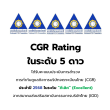
  • The Company participated in the Corporate Governance Report of Thai Listed Companies 2025 (CGR), organized by the Thai Institute of Directors (IOD) with support from the Stock Exchange of Thailand (SET).
  • The Company also demonstrates a firm commitment to anti-corruption by being a member of Thailand’s Private Sector Collective Action Against Corruption (CAC).

Performance in 2025

Corporate Governance

  1. Achieved an “Excellent” CGR rating from the IOD
  2. Selected as a SET ESG Rating 2025 constituent at level “A”
  3. Received a 5-coin rating for the Annual General Meeting (AGM) from the Thai Investors Association

Anti-Corruption

  1. Successfully renewed CAC membership (2nd certification) on 30 December 2023
  2. Implemented a No Gift Policy during New Year and festive seasons to ensure transparency
  3. Participated in the CAC “Speak Up” initiative
    Conducted anti-corruption training for all new employees during orientation
  4. Communicated anti-corruption policies to subsidiaries and business partners, with formal acknowledgment

In 2025, the Company received one whistleblowing report regarding non-compliance with company regulations. A formal investigation committee was appointed, and the case was resolved in accordance with the Company’s disciplinary procedures. 


3. Innovation and Technology Development

The Company continuously invests in innovation and advanced medical technologies to enhance treatment outcomes and service quality.

  • In 2025, the Company procured 26 items of medical software, equipment, and tools.
  • The Company also entered into a strategic partnership to establish the Siam Gamma Knife Therapy Center, the first and only facility in Thailand utilizing the Leksell Gamma Knife technology—a globally recognized standard for non-invasive treatment of brain and neurological disorders.

4. Data Privacy and Confidentiality

The Company has appointed a Data Protection Officer (DPO) responsible for overseeing the collection, storage, and protection of personal data of patients and service users.

Personal Data Complaint Channels
Information Technology Center, Vibhavadi Hospital
51/3 Ngamwongwan Road, Lat Yao, Chatuchak
Bangkok 10900, Thailand
Tel: +66 2 058 1111
Email: dpo@vibhavadi.co.th

Performance in 2025

The Company recorded zero cases of data breaches or complaints related to personal data leakage.

5. Supply Chain Management

The Company operates in accordance with good corporate governance principles while considering all stakeholders and promoting sustainable supply chain practices.
A Supplier Code of Conduct has been established and communicated to all business partners, encouraging ethical business conduct, legal compliance, and responsibility toward environmental and social issues, including labor and human rights, environmental management, occupational health and safety, business ethics, and anti-corruption.

Performance in 2025

  1. 100% of suppliers were assessed against the Company’s criteria, including ESG considerations
  2. Anti-corruption policies were communicated and acknowledged by subsidiaries and suppliers
  3. Conducted annual supplier site visits (10 companies in 2025)
  4. Held monthly meetings with business partners to support sustainable growth

In 2025, the Company recorded zero cases of ethical, legal, or corruption violations within the supply chain.

6. Sustainable Partnerships

The Company places strong emphasis on building and maintaining relationships with business partners, recognizing their critical role in supporting operations and enhancing the quality of healthcare services.
The Company fosters sustainable collaboration based on transparency, fairness, and mutual growth.

Performance in 2025

The Company held regular monthly meetings with subsidiaries, affiliates, and business partners to discuss future business directions and collaborative initiatives. These include knowledge-sharing programs, medical support initiatives, and sustainability efforts covering environmental, social, and community aspects.
The Company also encourages subsidiaries, affiliates, and partners to join its anti-corruption initiatives, aligning with the Company’s policies and practices to promote ethical and sustainable business conduct.

Targets
  • Service User Satisfaction
    • Inpatient (IPD) Satisfaction: 97%
    • Outpatient (OPD) Satisfaction: 96%
  • Corporate Governance: Achieved an “Excellent” CGR rating (Corporate Governance Report)
  • Anti-Corruption Commitment: Maintained continuous certification as a member of Thailand’s Private Sector Collective Action Against Corruption (CAC)
  • Zero complaints related to corruption or misconduct
  • Data Privacy and Security: Zero data breach incidents
  • Supply Chain Integrity: No cases of ethical, legal, or corruption violations within the supply chain
  • Sustainable Partnerships: Conducted business partner engagement meetings at least once annually

Key Issues
  • S1 Human Capital Development
  • S2 Respect for Human Rights, Equality, and Fair Labor Practices
  • S3 Occupational Health, Safety, and Work Environment
  • S4 Community Engagement
Management Approach and Performance Outcomes

Human Capital Development and Employee Training
The Company is committed to strengthening organizational capability through continuous employee development and structured training programs. Training initiatives are designed to enhance knowledge, skills, and career progression, while ensuring alignment with organizational standards and policies.

Employee Training Programs

  • Pre-employment training
  • Performance-based training aligned with individual development needs
  • Career advancement training to support employee growth
  • Mandatory training in accordance with organizational policies and professional standards

Performance in 2025
The Learning and Development Department organized both internal and external training programs to enhance employees’ competencies and professional knowledge.
In 2025, a total of 4,058 employees participated in training programs, representing an increase of 1,823 employees compared to 2,235 employees in 2024.
This significant growth reflects the Company’s strong and ongoing commitment to human capital development.

Further details are as follows:

Training Indicators

Unit

Year

2023

2024

2025

Average Training Hours per Employee

Hours per person per year

20.70

13

17.61

Average Training Hours by Gender

    Male

Hours per person

20.70

15.93

220

    Female

Hours per person

20.70

13

34

Average Training Hours by Employee Level

    Senior Management

Hours per person

20.70

24

48

    Physicians and Nurses

Hours per person

20.70

24.92

48

Average Training Expenditure

THB per person per year

2,371.75

592.73

592.02

Employee Training Hours and Training Expenditure


Employee Engagement
In the highly competitive healthcare industry, medical professionals and employees are critical drivers of competitive advantage and sustainable organizational growth. The Company places strong emphasis on employee well-being as a key priority.

To support this, the Company has established fair and competitive compensation and benefits policies for employees and their families, ensuring adequacy for cost of living. These include cost-of-living allowances, provident fund contributions, inpatient medical treatment benefits at no cost, family healthcare discounts, funeral assistance, recreational activities, and various family-oriented welfare programs.

Performance in 2025
The Company implemented the “HAPPINOMETER” program, an employee engagement survey designed to assess organizational commitment and gather employee feedback. The insights are used to improve key areas such as knowledge development, work-life balance, health, family well-being, and employee benefits.
As a result, the employee engagement score reached 70.34%.

Human Rights, Equality, and Labor Practices 

  • The Company conducts a comprehensive Human Rights Due Diligence (HRDD) process to identify, assess, and mitigate potential human rights risks, ensuring the prevention of violations and minimizing impacts on stakeholders.
  • Grievance Channels for Human Rights Concerns
    - By Mail: Audit Committee 
                      Vibhavadi Hospital Public Company Limited
                      51/3 Ngamwongwan Road, Lat Yao, Chatuchak
                      Bangkok 10900, Thailand
    - Email: vibha_cac@vibhavadi.com
  • The Company has established remediation measures for affected individuals, including both financial and non-financial support, in the short and long term, to effectively address any human rights impacts arising from its operations.

Performance in 2025
The Company recorded zero complaints related to human rights violations.
 

Occupational Health, Safety, and Work Environment

The Company is committed to ensuring a safe and healthy working environment through comprehensive occupational health and safety programs.

Occupational Health Initiatives

  • Annual employee health check-ups
  • Influenza vaccination (quadrivalent vaccine)

Workplace Safety and Environment Measures

  • Monitoring of indoor lighting quality within hospital facilities
  • Monitoring of indoor air quality and surrounding environmental conditions
  • Building inspections conducted by independent inspectors to ensure safety standards
  • Fire prevention training and emergency preparedness drills, including mass casualty incident simulations
  • Annual emergency response drills for emerging infectious diseases (2025)

The General Administration Department is responsible for monitoring and reporting on occupational health, safety, and environmental performance, with regular monthly reporting to the Executive Committee. The department also oversees ongoing environmental management within the Company’s operations.

Performance in 2025

Occupational Health and Safety Performance

Unit

2023

2024

2025

– Employees

Hours

3,796,000

3,822,280


– Contractors

Hours

72,248

95,824


Number of Incidents

– Employees

Cases

13

14


– Contractors

Cases

0

0


Lost Time Injury Cases (LTI)
– Employees

Cases

0

0


– Contractors

Cases

0

0


Total Recordable Injury Frequency Rate (TRIFR) 
(per 1 million working hours)

– Employees


3.42

3.66


– Contractors


0

0


Lost Time Injury Frequency Rate (LTIFR)
(per 1 million working hours)

– Employees


0

0


– Contractors


0

0


Note: There were zero work-related fatalities during the reporting period.

The Company remains committed to maintaining a safe workplace, with continuous monitoring and preventive measures to minimize occupational risks and ensure zero lost-time injuries across both employees and contractors. 

Health Program

Health Program Participation (Person)

2023

2024

2025

Influenza Vaccination (Quadrivalent)

1,003

1,027

1,016

Annual Health Check-ups

1,290

1,288

1,264

Workplace Safety and Environment
The Company is committed to maintaining a safe, healthy, and conducive working environment in accordance with applicable standards and regulations.

Performance in 2025

  • Air Quality Monitoring: Within standard limits
  • Lighting Quality Assessment: Within standard limits
  • Building Inspection: In normal and safe condition

In 2025, the Company was honored with the Building Safety Award 2025 (25-Year Building Category) at the Silver Level, presented by the Department of Public Works and Town & Country Planning.


Community Engagement
The Company has established dedicated functions responsible for coordinating with external stakeholders, including district offices, municipalities, local communities, and other relevant organizations. The Company actively participates in meetings and stakeholder engagement activities to gather feedback and strengthen collaboration.

In addition, the Company organizes initiatives to enhance public access to health assessments and promote appropriate self-care practices. Medical knowledge and healthcare education are delivered by experienced medical professionals to the general public, government agencies, patients, and their families through both on-site and online platforms.
 

Further details of activities are available on the Company’s website:
https://www.vibhavadi.com/th/news
Health-related articles and educational content can be accessed at:
https://www.vibhavadi.com/th/blogs

Community Engagement Activities in 2025

  • Conducted Basic First Aid and Cardiopulmonary Resuscitation (CPR) training for the general public (6 sessions), continuing for the 26th consecutive year
  • Delivered CPR and Automated External Defibrillator (AED) training at Kasetsart University Laboratory School on 11 December 2025
  • Organized a free health check-up activity for individuals exercising at Suan Rot Fai Park on 1 December 2025
  • Deployed a mobile medical volunteer unit at Thamaka School, Thamaka District, Kanchanaburi Province on 8 December 2025
  • Held a stakeholder and community meeting on 22 April 2025 to develop annual plans for health promotion, disease prevention, and community clinical services

Performance in 2025
Zero community complaints

Targets
  • Employees receive a minimum of 8 training hours/person/year
  • Employee engagement level exceeds 70%
  • Zero cases of human rights violations or related complaints
  • Zero community complaints
  • Zero work-related accidents

Key Issues
  • E1 Waste and Waste Management
  • E2 Energy Consumption
  • E3 Water and Wastewater Management
  • E4 Greenhouse Gas Management
Management Approach and Performance Outcomes

Waste and Waste Management

Effective waste and waste management is a critical aspect of healthcare operations. The Hospital has established a Waste Management Committee to ensure efficient, timely, and compliant handling and disposal of waste. This includes systematic monitoring of waste segregation, storage, collection, handling, transportation, and disposal processes.

Management Approach

  1. Waste Segregation at Source
    The Hospital has implemented a waste segregation policy at the source, with clearly defined waste categories, color-coded containers, and standardized labeling. Training programs are regularly conducted to enhance staff awareness and compliance.
  2. Comprehensive Waste Management Plan
    A structured waste management plan has been developed covering all types of waste, including chemical and hazardous substances. The plan outlines procedures from segregation, storage, and collection to transportation and final disposal.
  3. Controlled Waste Handling and Transportation
    Dedicated waste carts are used to ensure safe handling, with clearly designated routes and schedules for waste transportation within the Hospital.
  4. Improved Waste Storage Facilities and External Coordination
    Waste storage areas for general, infectious, and hazardous waste have been upgraded to meet hygiene standards. The Hospital collaborates with authorized external agencies for proper waste disposal, including the Bangkok Metropolitan Administration, Krungthep Thanakom Co., Ltd., and Akkhi Prakan Public Company Limited.

In addition, infectious and hazardous waste is treated using high-temperature incineration, with operating temperatures not lower than 760°C and 1,000°C, in compliance with the Ministerial Regulation on the Disposal of Infectious Waste B.E. 2545 (2002) issued by the Ministry of Public Health, and the Bangkok Metropolitan Administration Regulation on Waste and Sewage Management for Buildings and Healthcare Facilities B.E. 2545 (2002). 

Performance in 2025

In 2025, the average amount of infectious waste per inpatient day was 10.02 kilograms, representing a decrease of 0.16 kilograms per day compared to 10.18 kilograms per day in 2024.

The reduction was primarily attributed to a decrease in the number of patients during the year, resulting in a corresponding decline in total waste generation.

The Hospital generated a total of 59,119 kilograms of recyclable waste, which was transferred to certified recycling partners for proper processing. Revenue from the sale of recyclable materials amounted to THB 143,817, which has been allocated to support environmental and social initiatives in 2026.

Energy Consumption

The Company has been actively implementing energy efficiency measures since 1998, as reflected by its recognition through the Outstanding Energy Conservation Building Award from the Department of Energy Development and Promotion, Ministry of Science, Technology and Environment. The Company continues to prioritize energy management as a key operational focus.

Key Energy Efficiency Measures in 2025

  1. Upgrade to high-efficiency lighting systems
    Resulting in energy savings of 36,707.40 kWh/year, equivalent to THB 157,841.22 per year
  2. Reduction of water pump energy consumption during on-peak periods. Saving 101,835 kWh/year, equivalent to THB 491,863 per year
  3. Optimization of cooling tower and chiller operations during on-peak periods. Achieving savings of 353,320 kWh/year, equivalent to THB 1,706,536 per year, without affecting cooling performance
  4. Reduction of chilled water pump energy consumption during on-peak periods. Saving 43,800 kWh/year, equivalent to THB 211,554 per year, without impacting system efficiency

These three on-peak energy reduction measures have been continuously implemented since 2023.

In addition, the Company actively promotes energy-saving awareness among employees, encouraging the practice of turning off lights and electrical equipment when not in use.

 Performance in 2025

In 2025, the Hospital recorded total electricity consumption of 10,487,000 kWh, representing a reduction of 1,192,000 kWh compared to 11,679,000 kWh in 2024.

This decrease was primarily attributed to a lower bed occupancy rate, resulting in reduced overall energy demand.

In addition, the Hospital has implemented various initiatives and management approaches to reduce electricity consumption, including promoting employee awareness on energy conservation, encouraging the shutdown of unnecessary lighting and equipment, utilizing energy-efficient lighting systems, optimizing air-conditioning temperature settings, and installing solar panels as a renewable energy source.

Furthermore, the Company has established dedicated teams responsible for the maintenance and optimization of electrical systems to ensure efficient operation and energy savings. The management also places strong emphasis on the adoption of renewable energy, including the installation of solar panels across five buildings, contributing to on-site electricity generation as follows:

Year

Electricity Generation from Solar Energy

2022

524,467 kWh

2023

536,104 kWh

2024

516,994 kWh

2025

500,711 kWh

Water and Wastewater Management

Wastewater Management
The Company conducts regular inspection and maintenance of wastewater pumps in the central wastewater holding system. Chlorination is continuously applied to disinfect wastewater, and samples are collected and tested on a monthly basis prior to discharge.

All wastewater is discharged into the Bangkok Metropolitan Administration’s closed sewer system and treated at the Din Daeng centralized wastewater treatment facility.

The system design and installation have been reviewed and approved by Bangkok Metropolitan Administration officials. In addition, relevant hospital departments have participated in site visits and ongoing monitoring of the treatment system. Monthly follow-ups are conducted through official reports obtained from the Bangkok Metropolitan Administration, significantly reducing the risk of wastewater treatment system failure.

Water Consumption Reduction
The Company has implemented water-saving initiatives, including the gradual installation of sensor-based faucets in public restrooms to reduce unnecessary water usage.

In addition, awareness campaigns are conducted through signage and internal communication to encourage water conservation among patients, visitors, and staff.

Performance in 2025

In 2025, the Hospital’s total water consumption decreased by 13,182 cubic meters compared to 2024.

However, when measured as water consumption per patient day, the figure slightly increased to 1.94 cubic meters, representing a 2.11% increase from 1.90 cubic meters in 2024.

Based on these results, the Company will continue to implement and enhance water management strategies to ensure that water consumption aligns with its established targets.

Greenhouse Gas Management

The Company has initiated a systematic approach to measuring greenhouse gas (GHG) emissions by establishing a dedicated working team responsible for data collection and identifying initiatives to reduce emissions across its operations.

In early 2025, the Company participated in a pilot program for the Organizational Carbon Footprint Platform, organized by the Thailand Greenhouse Gas Management Organization (Public Organization), as part of its commitment toward achieving Net Zero emissions.

Performance in 2025

The Company has measured its greenhouse gas emissions across all scopes, including:

  • Scope 1: Direct emissions from fuel combustion
  • Scope 2: Indirect emissions from purchased energy
  • Scope 3: Other indirect emissions

The results are as follows:

      Based on the Company’s performance in 2025, greenhouse gas (GHG) emissions were reduced by 13.05% compared to 2024, significantly exceeding the short-term target of a 2% reduction, as detailed in the table above. The Company remains committed to continuously improving its operational processes to achieve its long-term sustainability goals.

      In addition, the Company participated in the “Care the Bear” initiative, which focuses on promoting behavioral changes within organizations to reduce GHG emissions from events and activities.

      In 2025, the Company successfully reduced paper usage in its activities, contributing to a measurable reduction in greenhouse gas emissions, as detailed below:
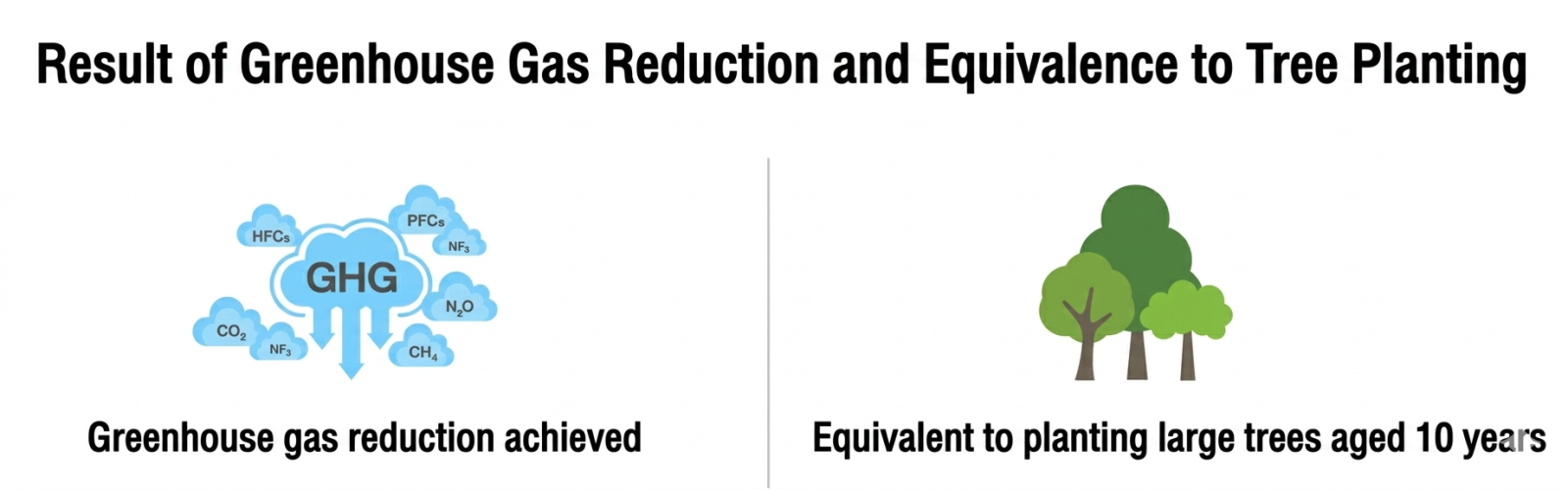
2024

21,929.45 kgCO2eq

2,437 Trees

2025

21,760 kgCO2eq

2,290 Trees

Total

43,689.45 kgCO2eq

4,727 Trees

In 2025, the Company was rated “A” in the SET ESG Ratings by the Stock Exchange of Thailand, reflecting its strong commitment to sustainable business practices.

This achievement demonstrates continuous improvement from the “BBB” rating in 2024, and underscores the Company’s dedication to further enhancing its sustainability performance toward higher levels in the future.

Targets
  • The average waste generated per inpatient day decreased by more than 1% compared to the previous year
  • The estimated average electricity consumption per patient day decreased by more than 1% compared to the previous year
  • The average water consumption per patient day decreased by more than 1% compared to the previous year
  • Short-term target: Reduce greenhouse gas (GHG) emissions by 2% year-on-year
  • Long-term target: Achieve net-zero greenhouse gas emissions by 2065, in alignment with Thailand’s national target

Overview of Operational PerformanceVibhavadi’s Sustainability Performance

Corporate Governance and Economic

Total Revenues 6,578.27   million baht

Total Revenues

6,578.27 million baht

Profit attributable to Owners of the Parent 468.49   million baht

Profit attributable to Owners of the Parent

468.49 million baht

Dividend per share 0.050 baht per share

Dividend per share

0.050 baht per share

EBITDA 1,317.86 million baht

EBITDA

1,317.86 million baht

Subsequently to profit or loss 149.79 million baht

Subsequently to profit or loss

149.79 million baht

Personnel-related expenses 127.43 million baht

Personnel-related expenses

127.43 million baht

Management's endorsement of the anti-corruption policy 100%

Management's endorsement of the anti-corruption policy

100%

ผู้บริหารตอบรับ จรรยาบรรณธุรกิจ 100 %

ผู้บริหารตอบรับ จรรยาบรรณธุรกิจ

100 %

Supplier Assessment 100%

Supplier Assessment

100%

Management of the local (Thailand) procurement supply chain

Management of the local (Thailand) procurement supply chain

Measurement of customer satisfaction rate HAPPY 97%

Measurement of customer satisfaction rate

HAPPY 97%

Number of Beds

2,323 Beds

Patient Capacity

27,480 Patients per day

Examination Room

684 Room

Social

Number of employees 2025 1,367 Person

Number of employees 2025

1,367 Person

Man

13.83%

Female

86.17%

Employment of persons with disabilities: 6 employees (0.44%)
Employment of elderly persons: 18 employees (1.32%)

Average training hours per employee 17.61 Hours/person/ year

Average training hours per employee

17.61 Hours/person/ year

  • The company organized a total of 230 internal and external training courses.

  • A total of 4,058 employees received training, averaging 17.61 hours per person per year.

  • The expenses for employee development amounted to 2,402,400 Baht.

Human rights violations throughout the value chain 0 %

Human rights violations throughout the value chain

0 %

Work-related fatalities 0 %

Work-related fatalities

0 %

Community complaints 0 %

Community complaints

0 %

โรงพยาบาลที่รับประกันสังคม No

โรงพยาบาลที่รับประกันสังคม

No

Environment

Greenhouse Gas (GHG) emissions 2025 21,760 Kg CO₂eq

Greenhouse Gas (GHG) emissions 2025

21,760 Kg CO₂eq

Proportion of greenhouse gas emissions categorized Scope

Scope 1

30.73%

Scope 2

44.59%

Scope 3

17.46%

Scope Other

7.22%
Total Electricity Consumption in Operations 13,411,271 kWh

Total Electricity Consumption in Operations

13,411,271 kWh

Energy Consumption per Revenue

3,842

kWh/MB

Total Electricity Generated from Solar Cell 500,711  kWh

Total Electricity Generated from Solar Cell

500,711 kWh

Energy Consumption per Revenue

3,842

kWh/MB

Total Oil and Fuel Consumption 24,958.84 Liters

Total Oil and Fuel Consumption

24,958.84 Liters

Energy Consumption per Revenue

7.02 Liters/MB

Water Withdrawal from Various Sources <span>(Water from Production Processes, Groundwater, and Tap Water)</span> 163,199 Cubic Meters

Water Withdrawal from Various Sources (Water from Production Processes, Groundwater, and Tap Water)

163,199 Cubic Meters

ปริมาณการนำน้ำมาใช้ต่อรายได้

56

m³/MB